Germany’s Quint Raises 9.1 Million Euros to Develop Quantum Chips With Fewer Errors


Insider Brief
- German quantum computing startup Quint raised 9.1 million euros in its first funding round to develop chips designed to reduce errors and lower error-correction costs.
- Vsquared Ventures led the round, with participation from Quantonation, Nucleus Capital and industry specialists, including IQM co-founder Mikko Möttönen.
- Quint plans to use contract manufacturers for production and must demonstrate that its chip architecture retains its advantages at the scale of hundreds of qubits.
- Image: Quint Computing
German quantum computing startup Quint has raised 9.1 million euros in its first funding round to develop chips designed to reduce errors and lower the cost of building reliable quantum computers, Handelsblatt reported.
The financing, secured a little more than a year after the company’s founding, was led by Vsquared Ventures. Participants included Quantonation, Nucleus Capital and industry specialists such as IQM co-founder Mikko Möttönen, according to the newspaper.
Handelsblatt described the round as the largest raised by a German quantum computing company at such an early stage. Quint has also received a European Union funding award of more than 2 million euros, the newspaper reported.

The company is targeting one of quantum computing’s central engineering problems: Errors make calculations unreliable and require additional hardware to detect and correct them. Quint’s approach seeks to suppress a substantial share of those errors within the chip’s circuit elements.
“Error correction is the biggest cost driver in quantum computing today,” quantum physicist and investor Ion Hauer told Handelsblatt.
Reducing errors within a chip could reduce the resources needed to correct them, Hauer told the newspaper.
Reducing Errors Through Chip Design
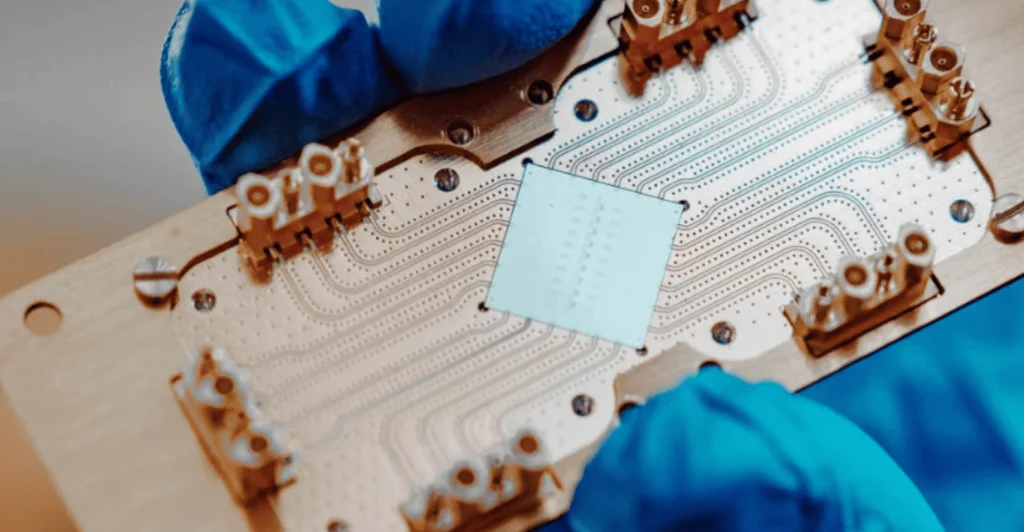
Quint has developed a patented architecture for superconducting quantum chips, according to Handelsblatt. Superconducting circuits operate without electrical resistance and provide the basis for the company’s approach to processing quantum information.
Quantum computers use quantum bits, or qubits, whose states can combine the possibilities represented by zero and one. They use the rules of quantum mechanics to perform calculations, with potential applications that include simulations of chemical systems and optimization calculations for finance.
Protecting quantum information generally requires redundancy, spreading information across multiple physical qubits so that errors can be identified and corrected. That increases the number of qubits needed to perform reliable calculations.
Quint aims to reduce that burden by coordinating the design of its circuit elements with the electrical signals used to control them.
“We have developed an architecture in which the physical structure and wiring of the component work together with its electrical control,” co-founder Michael Hartmann told Handelsblatt.
Hartmann said that arrangement provides greater stability. Nucleus Capital investor Maximilian Schwarz told the newspaper that the architecture could shorten the path to fault-tolerant systems and make them less expensive. Such systems are designed to carry out reliable calculations despite errors in their underlying components.
Industrial Customers and Contract Manufacturing
Quint is a spinoff of Friedrich Alexander University Erlangen-Nuremberg. Its founding team includes quantum physicists Hartmann and Christopher Eichler, along with economist Jona Stinner.
Hartmann previously spent years working for Google’s quantum team. He and Eichler spent years developing the chip architecture before establishing the company, according to Handelsblatt.
The founders deliberately chose Munich and Germany as the company’s base, citing proximity to potential industrial customers. Hartmann pointed to chemical producer BASF and pharmaceutical company Bayer as examples of companies in the market Quint hopes to serve.
Handelsblatt reported that experts expect chemistry and pharmaceuticals to be among the first sectors to gain substantial economic benefits from quantum technologies.
Quint plans to move quickly toward commercialization and make its technology compatible with a broad range of requirements, Eichler told the newspaper.
Over the medium term, the company intends to use contract manufacturers rather than handle all production itself. Handelsblatt compared that planned division of design and manufacturing to NVIDIA’s business model.
The transition to production will test whether Quint’s circuit design can retain its advantages as systems grow.
“A patent on a better circuit is not yet a chip that works in large quantities,” Hauer told Handelsblatt.
Quint must demonstrate that its advantage holds at the scale of hundreds of qubits, Hauer said. It also faces competitors such as Google and IBM, which have invested billions in quantum computing, he told the newspaper.
Hauer said a successful move from the laboratory to manufacturing could make Quint one of Europe’s most promising quantum investments.
The article was based on a computer translated version of the online story.

Keep track of everything going on in the Quantum Technology Market. In one place.
Topics

Matt Swayne
With a several-decades long background in journalism and communications, Matt Swayne has worked as a science communicator for an R1 university for more than 12 years, specializing in translating high tech and deep tech for the general audience. He has served as a writer, editor and analyst at The Quantum Insider since its inception. In addition to his service as a science communicator, Matt also develops courses to improve the media and communications skills of scientists and has taught courses.
[email protected]

Stay Ahead of Quantum
Get the latest research, company news, and market intelligence every week.
MENTIONED IN THE ARTICLE

Vsquared
Vsquared Ventures is a deep tech focused early stage VC based in Munich. We believe, that technology and radical entrepreneurship are our best chance to tackle the most pressing issues of markets, industries and human mankind. Backed by pioneering entrepreneurs and techies we create a reinforcing ecosystem to provide interdisciplinary knowledge and access for those inventing the future and together push their companies to the next Level. Focus areas are New Space, Quantum computing, New Materials, AI, Robotics and Enterprise SaaS.
→

Quantonation
Quantonation is an Early Stage Venture Fund dedicated to Deep Physics startups with a focus on the emerging and disruptive field of Quantum Technologies.
→

IQM
IQM Finland builds scalable hardware for universal quantum computers, focusing on superconducting technology.
→

Friedrich-Alexander University
Friedrich-Alexander University, also known as the University of Erlangen-Nuremberg, is a public research university located in Erlangen and Nuremberg, Bavaria, Germany. It was founded in 1743 and is one of the oldest and most prestigious universities in Germany. The University of Erlangen-Nuremberg offers over 260 degree programs, including 50 programs that have been developed for international students.
→

Google
Google is a global technology powerhouse, founded in 1998, that is actively expanding its footprint into aerospace. The company pioneers AI driven satellite telemetry analysis, collaborates with the The Aerospace Corporation, researches space weather forecasting, and tests orbital data center concepts like Project Suncatcher. Google’s Project Suncatcher is an aerospace "moonshot" exploring orbital data centers. It envisions constellations of solar-powered satellites operating in sun-synchronous Low Earth Orbit (LEO).
→
BASF
BASF SE is a multinational chemical company and the largest chemical producer in the world.
→

Bayer
Bayer AG is a German multinational pharmaceutical and life sciences company and one of the largest pharmaceutical companies in the world.
→
NVIDIA
NVIDIA Corporation is an American multinational technology company and a global player in accelerated computing and Artificial Intelligence (AI). Founded in 1993, the company pushes the aerospace frontier with the Space-1 Vera Rubin Module, a platform for orbital data centers that delivers massive AI-compute Space Computing. This NVIDIA technology enables satellites and autonomous spacecraft to process and fuse sensor data rapidly Space Computing.
→

IBM
IBM is an iconic technology pioneer founded in 1911 as the Computing-Tabulating-Recording Company and officially renamed International Business Machines Corporation in 1924. Beyond foundational computing, IBM possesses a deep legacy in aerospace and defense from building the guidance computers and Instrument Unit for NASA's historic Apollo missions to partnering with Airbus on CIMON, the first AI assistant on the ISS.
→